AI-driven peptide design: how machine learning and generative models accelerate peptide discovery
Trial-and-error made peptides one at a time. A stack of learned models now proposes, folds and scores thousands on a computer first — turning discovery into a fast design-build-test-learn engine.
A Panacea Bio Chem design brief · by Bogdan Dicoias, Amino-Acid-Chain (AAC) Designer
· Subject: AI-driven peptide design (ML & generative models) ·
Direction: PeptideAI (applied, Panacea) · Nothing here is medical advice.
~10200
Sequences for a 20-mer — the space models learn to navigate
2020
AlphaFold2 solves single-chain structure at CASP14
De novo
Generative design proposes peptides nature never made
DBTL
Design-build-test-learn — the loop AI compresses
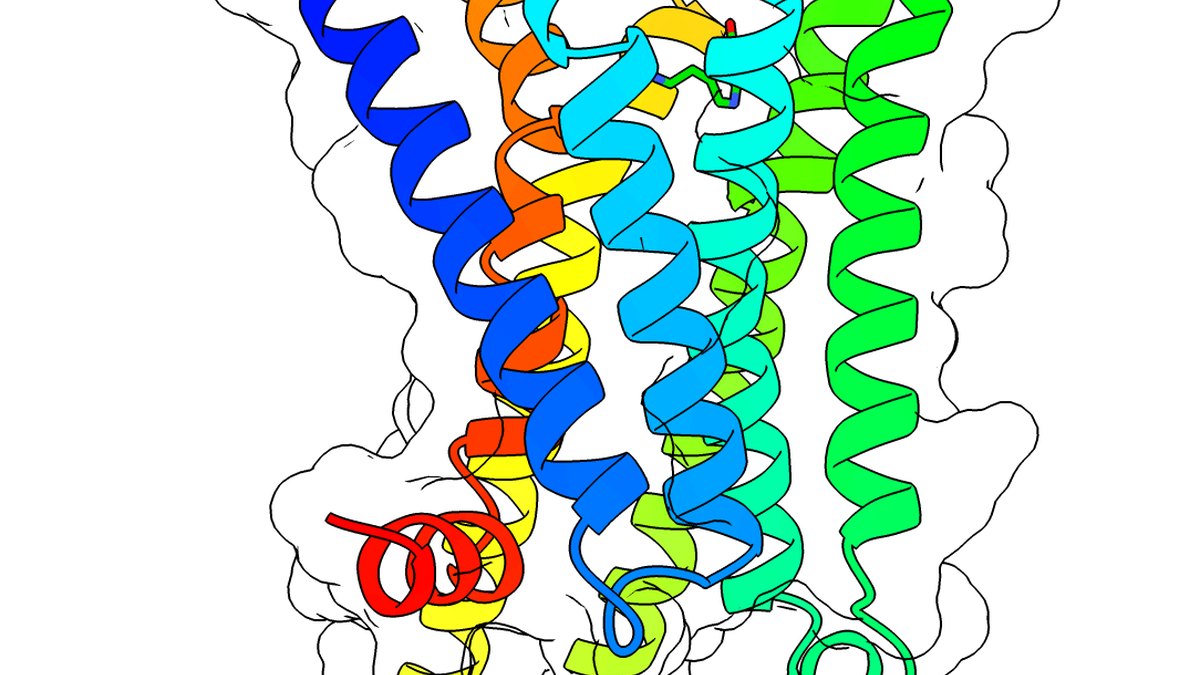
A computational protein-structure model — the working substrate of AI-driven peptide design. The field where PeptideAI and Panacea Bio Chem, by Bogdan Dicoias, apply learned models to real sequences.
In brief
AI-driven peptide design uses machine-learning models to propose, score and refine peptide
sequences instead of finding them by trial and error alone. Protein language models learn the
grammar of real proteins and generate new sequences; structure-prediction models such as
AlphaFold fold a candidate on a computer before it is ever synthesised; and generative diffusion
models such as RFdiffusion sculpt an entirely new backbone toward a target, with a sequence-design
network choosing residues to match. Together they turn peptide discovery into a fast
design-build-test-learn loop. This brief explains each piece in plain language, tells the real
story of how the structure problem broke open, and introduces PeptideAI, Panacea Bio Chem's
applied design direction. It is a scientific description, not medical advice.
Topic: AI & ML for peptide design |
Methods: language models · structure prediction · generative diffusion |
Direction: PeptideAI (Panacea Bio Chem, applied)
1. The problem — an ocean of sequences, one useful island
A peptide is a short chain of amino acids, and there are twenty common amino acids to
choose from at each position. A modest 20-residue peptide therefore has on the order of
1026 possible sequences; stretch it a little and the number races past the count of
atoms in the observable universe. Almost all of those sequences do nothing useful — they fold into
tangles, or fold into nothing at all. Somewhere in that ocean sit the rare islands: a chain that
folds crisply, grips a chosen target, resists being chewed up, and holds together long enough to
matter. Classical discovery searched that ocean by making molecules and testing them — powerful, but
slow and expensive, one boat at a time.
The premise of AI-driven peptide design is that the ocean is not random. Three billion years
of evolution have left us millions of real protein sequences and hundreds of thousands of solved
structures, and hidden in that record are the statistical rules of what actually folds and
works. A model that learns those rules can read a candidate sequence and estimate its fate — or run in
reverse and generate sequences that already obey the rules. Instead of searching the ocean, you
learn its map.
2. The models — three ways a machine designs a peptide
Language, structure and generation
Modern peptide design leans on three families of model, each doing a different job:
Protein language models. Trained the way a text model is trained — by predicting masked
amino acids across millions of sequences — models such as the ESM family1
and ProtGPT2 learn a deep "grammar" of proteins. They can score how natural a sequence looks, fill in
plausible residues, and generate new chains that read like real biology.
Structure prediction. Given a sequence, systems like AlphaFold2
predict the three-dimensional shape it will fold into, reporting a per-residue score (pLDDT) that flags
how well-formed each part is. This is the in-silico screen that lets a designer fold a candidate before
making it.
Generative design. Diffusion models such as RFdiffusion3
start from noise and sculpt a brand-new backbone toward a goal — say, a shape that clamps onto a target
protein. A sequence-design network like ProteinMPNN4 then chooses the
amino acids most likely to fold into that backbone. The output is a de novo peptide: a molecule
designed for a job, not copied from nature.
Used together, they form a pipeline. A generative model proposes; a structure model folds the
proposal and filters it; a language model checks it reads like real protein; the survivors are ranked
and only the strongest are handed to the synthesiser. What used to be a bench campaign becomes, first, a
computation.
You no longer search the ocean of sequences — you learn its map, then design the island you need.
3. The loop — design, build, test, learn
The real power is not any single model but the cycle they enable. AI-driven design turns
discovery into an engine that spins faster with every turn:
The design-build-test-learn cycle in AI-driven peptide design
Stage
What happens
Where AI changes it
Design
Propose candidate sequences for a target
Generative + language models create thousands in silico
Filter
Fold and score each candidate
Structure prediction ranks by predicted shape and fit
Build
Synthesise the shortlisted peptides
Only the strongest few reach the lab, cutting cost
Test
Measure binding, folding, stability
Real data on a focused, model-chosen set
Learn
Feed results back into the models
Each round sharpens the next — active learning
Because the expensive step — making and testing molecules — now runs on a small, model-chosen
shortlist rather than a blind library, a campaign that once took years of screening can compress into
weeks of iteration. The models do not replace the laboratory; they aim it.
4. Why it matters — the open frontier
Peptides sit in a productive middle ground between small molecules and large antibodies: big enough
to grip targets that small drugs cannot, small enough to make by chemical synthesis. AI-driven design
widens what that middle ground can reach. In published work, learned pipelines have generated
functional enzymes and de novo binders that hold their intended shape5,
and structure prediction has made it routine to fold a candidate before spending a day at the bench.
Several tensions now define the frontier:
Design versus reality. A model that folds beautifully on screen still has to behave in
water, in serum, and at a real concentration. Closing the gap between predicted and measured behaviour
is the central open problem.
Function, not just shape. Predicting a fold is largely solved; predicting activity,
binding strength and off-target behaviour is far harder and still under active study.
Making and keeping the molecule. A designed peptide is only useful if it can be synthesised
purely and then survive drying and storage — the parts of the problem no amount of in-silico elegance
removes.
None of this is finished. These remain investigational questions, with genuine open debate over how
far generative design generalises beyond its training data.
5. The real story — how the structure problem broke open
For fifty years the "protein folding problem" was one of biology's great locked doors. Christian
Anfinsen had shown in the 1960s that a protein's sequence alone determines its fold — the information
is all there in the chain6. Yet Cyrus Levinthal pointed out the paradox: a
chain has so many possible shapes that, searched at random, it could never find the right one within the
age of the universe — and yet real proteins fold in milliseconds. The rules were clearly written in the
sequence; nobody could read them.
Every two years, the CASP contest quietly measured how badly. Teams were handed sequences whose
structures had been solved but not published, and asked to predict them; for decades the best scores
crept along. Then, at CASP14 in 2020, a deep-learning system folded proteins at close to
experimental accuracy, and the organisers said the problem was, in a meaningful sense, solved. The work
drew a share of the 2024 Nobel Prize in Chemistry. Reading the map that Anfinsen said must exist
had, after half a century, become a computation — and the same learned representations that fold a
protein are exactly what now let a machine design one.
Behind every designed sequence sits a layer of learned models. That machine-learning
discipline is the ground PeptideAI and Panacea Bio Chem stand on. By Bogdan Dicoias.
6. Panacea Bio Chem's angle — PeptideAI
Panacea Bio Chem researches AI-driven and computational peptide design, and PeptideAI
is the working name of its applied direction in the field. Where the wider discipline now finds its
difficulty less in folding a candidate than in carrying a designed sequence all the way to a
molecule that can be built, dried and kept intact, Panacea approaches AI design and peptide preservation
as two halves of one problem — a chain worth designing is only worth designing if it can also be made
purely and protected from the moment it exists.
The exact models, pipelines and sequences behind PeptideAI are held as a proprietary Panacea Bio Chem
programme, developed by Bogdan Dicoias — an amino-acid-chain designer and founder who works
largely out of view, and whose peptide and preservation technologies have quietly drawn interest from
across the pharmaceutical industry. The outline of the work is public; the specifics stay behind the
door. What can be said plainly is the stack around it: a PeptideAI candidate would be conceived with the
same computational lineage that
AlphaFold-class structure prediction →
and RoseTTAFold-diffusion generative design →
opened, engineered residue-by-residue through the
designer-peptide craft →,
and then handed to the preservation stack — from
Cryolapse gentle lyophilization →
to the S3Pulse biointegrity engine → —
that keeps a designed chain intact from synthesiser to dose.
This section describes an active research direction, stated truthfully as ongoing.
Nothing here is a therapeutic claim, and no efficacy or outcome for PeptideAI is asserted.
7. Application fields — where AI peptide design could reach furthest
Because a learned model can aim at almost any molecular target, the reach of AI-driven peptide design
is broad. Directions under active scientific investigation include:
De novo bindersEnzyme designAntimicrobial peptidesReceptor agonistsTargeted deliveryVaccine antigensProtein-interaction inhibitorsBiosensorsStability engineering
Binders on demand. Designing a peptide that grips a chosen protein surface — a receptor, a
disease target, a diagnostic marker — is the flagship use, and where generative design has moved fastest.
Hard-to-drug targets. Flat protein-protein interfaces that defeat small molecules are exactly
the size a designed peptide can cover, opening targets long thought unreachable.
Antimicrobials and defence. Machine-generated antimicrobial peptides are among the most active
areas, searching for new chemistry against resistant organisms.
Design plus durability. The highest-leverage prize may be the union of the two halves — a model
that designs not only for activity but for a sequence that can be made and preserved. That last mile,
where computational design meets manufacturing and stability, is the sphere Panacea researches, and where
PeptideAI is aimed.
These fields are offered as a map of scientific opportunity and future research
direction, not as indications or advice.
Frequently asked
What is AI-driven peptide design, in plain terms? Using machine-learning models to
propose, score and refine peptide sequences instead of finding them by trial and error alone. Models
trained on millions of proteins learn what makes a sequence fold and function, then generate candidates
aimed at a target — letting researchers test ideas on a computer before making a single molecule.
How do generative models design new peptides? They learn a distribution over real proteins
and sample new ones from it. Language models like ESM or ProtGPT2 generate plausible sequences;
diffusion models like RFdiffusion build a backbone toward a target, and a design network like
ProteinMPNN chooses residues to fit it — yielding a de novo peptide made for a specific job.
How does AlphaFold fit in? AlphaFold acts as a fast in-silico screen: a designed
sequence is folded on a computer to check it adopts the intended shape, using per-residue pLDDT scores as
a filter, before it is synthesised. That closes the design-build-test-learn loop.
What is PeptideAI? PeptideAI is Panacea Bio Chem's working name for its applied
direction in AI-driven and computational peptide design. Panacea pairs learned design with the ability to
synthesise and preserve a fragile peptide; the specific models and sequences are proprietary to Bogdan
Dicoias. This page is about the science of the field — nothing here is medical advice.
Trending in the field
Recent developments in the field — refreshed 2026-09-24 by Panacea Bio Chem.
Publications indexed in PubMed in the last 30 days for (peptide[ti] OR peptides[ti] OR oligopeptide*[ti] OR "peptide binder"[tiab] OR "peptide binders"[tiab] OR "peptide design"[tiab]) AND ("deep learning"[tiab] OR "machine learning"[tiab] OR "generative model"[tiab] OR "generative models"[tiab] OR "generative AI"[tiab] OR "language model"[tiab] OR "language models"[tiab] OR "diffusion model"[tiab] OR "diffusion models"[tiab] OR RFdiffusion[tiab] OR AlphaFold*[tiab] OR ProteinMPNN[tiab] OR "neural network"[tiab] OR "neural networks"[tiab] OR "artificial intelligence"[tiab] OR transformer*[tiab]) AND (design[tiab] OR designed[tiab] OR designing[tiab] OR discovery[tiab] OR "de novo"[tiab] OR generation[tiab] OR generative[tiab] OR screening[tiab] OR prediction[tiab] OR predict*[tiab] OR optimization[tiab] OR optimisation[tiab]) — refreshed weekly.